Teyata om bekanze bekanze, maha bekanze, radza samudgate soha.
Teyata om bekanze bekanze, maha bekanze, radza samudgate soha.
MEDICINE BUDDHA
In Buddhism, Medicine Buddha is a deity who is revered as a symbol of healing and as the embodiment of the healing power of the Buddha's teachings. The Medicine Buddha is considered to be a manifestation of the Buddha of infinite light and compassion, and is believed to have the power to heal both physical and mental ailments.
The Medicine Buddha is often depicted as a seated figure, with a coloured body and a serene expression. In his right hand, he holds a branch of the myrobalan plant, which is a symbol of healing, and in his left hand, he holds a begging bowl, which represents his selfless compassion and his commitment to helping others.
The practice of Medicine Buddha meditation and recitation is popular in many Buddhist traditions, and is believed to have the power to bring healing and spiritual benefits to those who engage in it.
Seven Medicine Buddhas:
Endowed with infinite compassion and the ability to guide all sentient beings to the shore of enlightenment, the Medicine Buddha has manifested in numerous forms, including those of seven Medicine Buddhas, to alleviate suffering and bestow happiness upon all sentient beings.
Mantra
Ttayatha om bekandze bekandze,
Maha bekandze,
Radza samudgate soha.
Tayatha: like this
Om: signifies the totality of one’s being and the universe
Bekandze: eliminating pain or eliminating suffering
Maha bekandze: eliminating great pain, suffering in the soul
Radza: king or sovereign
Samudgate or Samu Gate: ocean of goodness
Soha: blessing, devotion, gratitude from which the realization comes

Visualization
Above the crown of your head is a lotus. In its center is a white moon disc and seated upon that is your root guru - the dharmakaya essence of all the Buddhas—in the form of the Medicine Buddha. He is blue and his body radiates blue light.
His right hand, in the mudra of granting sublime realisations, rests on his right knee and holds a stem of the aurora plant between his thumb and index finger. His left hand, in the mudra of concentration, holds a lapis lazuli bowl filled with nectar. Seated in the vajra position, he wears the three saffron robes of a monastic. He has all the signs and marks of a Buddha.

Om tare tuttare, ture mama ayur, punye jnana pushtim kuru soha.
Om tare tuttare, ture mama ayur, punye jnana pushtim kuru soha.
This mantra is one of the most popular and auspicious mantras in Tibetan Buddhism. Indeed, the mantra brings good fortune, health, and long life to those who recite it. The White Tara mantra is believed to have originated from the Buddha himself. It is said that the Buddha taught this mantra to the bodhisattva Avalokiteshvara, who then passed it on to his disciples. As a result, the mantra has been translated into many languages and recited by Buddhists worldwide
The White Tara represents all the qualities of the Buddhas, such as compassion, wisdom, and strength. She is also the “Mother of All Buddhas”. It is believed that all Buddhas are born from their womb. Those who recite this mantra are said to receive her blessings of good health, long life, and good fortune.
WHITE TARA
Mantra
Om tare tuttare,
Ture mama ayur,
Punye jnana pushtim,
Kuru soha.
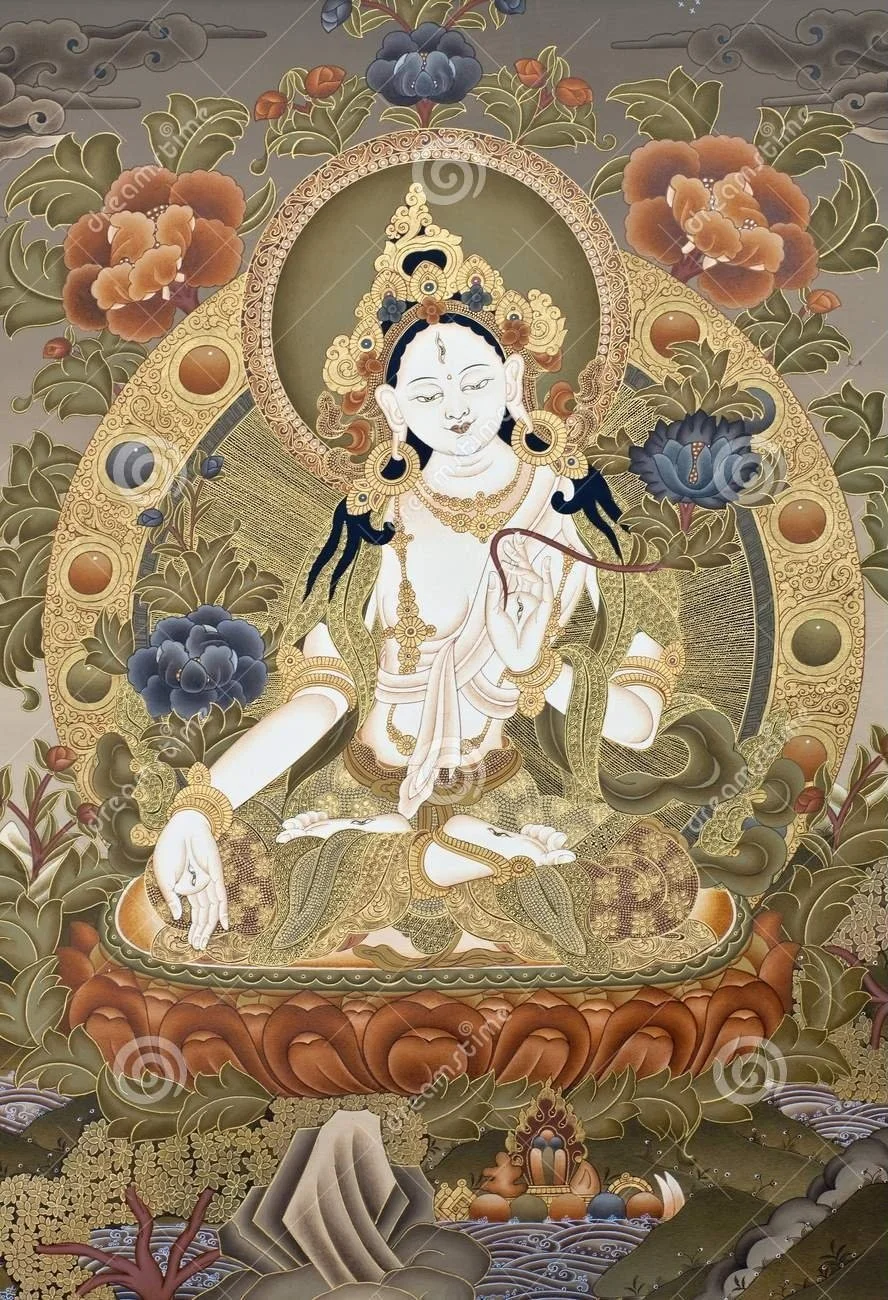
The meaning of “Om Tare Tuttare Ture Soha”: is “I bow to the Liberator (Tara), the Mother of all Buddhas”. The word “Tara” means “star” in Sanskrit. Therefore, she is often depicted as a beautiful goddess with seven stars around her head. The White
Tara represents all the qualities of the Buddhas, such as compassion, wisdom, and strength. She is also the “Mother of All Buddhas”. It is believed that all Buddhas are born from their womb. Those who recite this mantra are said to receive her blessings of good health, long life, and good fortune.
Visualization and mantra recitation
Above the crown of your head, the transcendental wisdom of all the Buddhas manifests as White Tara. Her body is in the nature of radiant white light. She has one face and two arms. Her right hand is on her right knee in the gesture of granting supreme realizations, and her left hand at her heart holds the stem of an utpala flower. Youthful and beautiful, she is seated in the vajra posture. She has all the signs and marks of a Buddha and has seven eyes (face, palms, soles, third eye). She looks at you and all sentient beings with complete acceptance and compassion.
At Tara’s heart is a horizontal white moon disk. At its centre is the white syllable TAM, the essence of her enlightened realisations. Light rays shine forth from the TAM and hook back all the life force that has been scattered or lost. This dissolves into the TAM in the form of light. Again light rays radiate from the TAM and hook back the power and inspiration of all the Buddhas, bodhisattvas and those who have attained the realisation of long life. This dissolves into the TAM. Also, the essence of the four elements of earth, water, fire and air, as well as the space element, absorb into the TAM in the form of coloured nectar-light (white, yellow, red, green, blue).
From the TAM at her heart, light and nectar now flow into your body. They fill your entire body, dispelling all negative karma, disturbing attitudes, negative emotions, disease, interferences, and dangers of untimely death. All these leave your body in the form of dirty liquid, and your body becomes pure and clear. Your mind too becomes clear and blissful.
While doing this visualization, recite 21 times.
Aka Sa Ma Ratza Sharara samara Yah Phat.
Aka Sa Ma Ratza Sharara samara Yah Phat.
Mantra
Aka Sa Ma Ratza Sharara samara Yah Phat
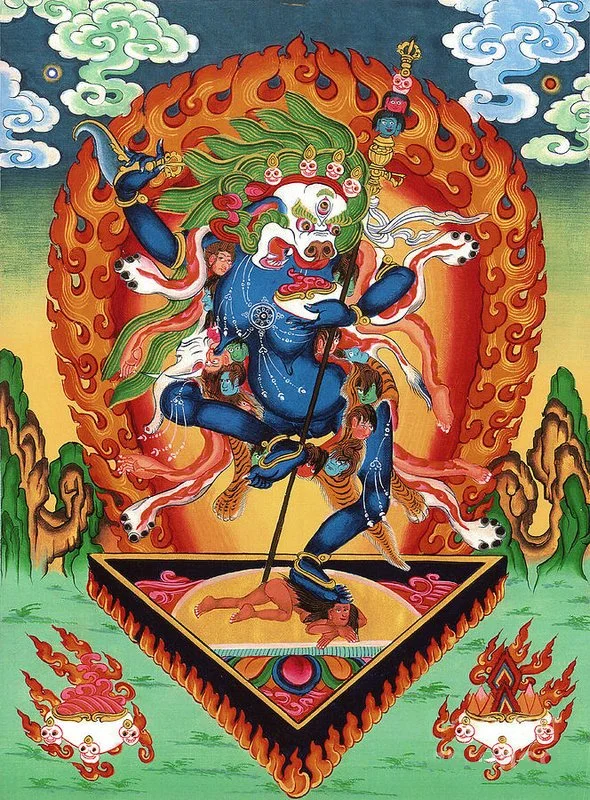
Why is Simhamukha, the Lion-Faced Dakini considered the “go to” practice in times of peril — especially any crushing supernatural or psychological threat. What is so special about her practice, that most lineages of Tibetan Buddhism turn to her practice in times of disaster, bad luck, illness, or any form of negative karma ripening? Lion-Faced Dakini, Simhamukha is among the most powerful, rapid, and awe-inspiring of the Wisdom Dakinis in Buddhism. Her mantra is often the first one chanted when a yogi practitioner feels threatened by any looming or deadly evil, curse, or bad luck, even black magic.
Despite her wrathful, exotic form, Simhamukha, the Snow Lion-Faced- Dakini (Sanskrit: Siṃhamukhā; Tibetan:sen-ge’i gdong ma or senge-dong-chen) is a Jnana Dakini or wisdom goddess. She is among the most popular of the Enlightened Buddhist Dakinis — in part due to her exotic and ferocious appearance — and her rapid activity in helping her practitioners.
Like all wisdom Dakinis, she is ultimately a super wrathful form of Wisdom, a fully Enlightened Buddha, and therefore considered ultimately an aspect of Tara.
SENGE DOLMA